
Snowboarding Guide
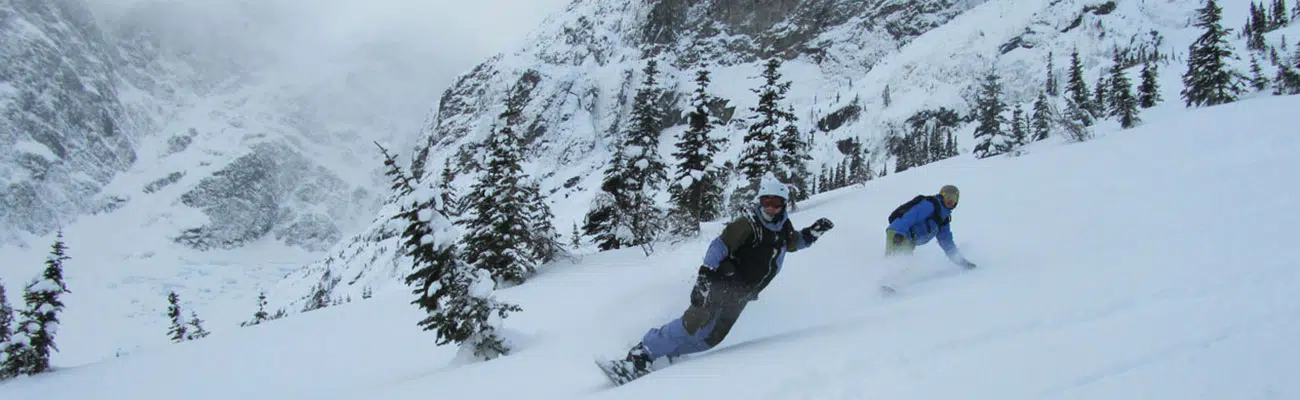
Snowboarding is a ride down a snow covered mountain surfing an endless winter wave. Float effortlessly through fresh powder, carve a perfect arc on recently groomed snow, hit the park to ride the rails, ramps, and jumps, or rip quick short turns in natural snow among the trees or along the slope edges. If snowboarding is so awesome, why do less than 25% of “skiers” do it? And why is snowboarding fading?
Snowboarding when done well looks cool, whether making quick fast turns or cruising with big “s” turns across the slope. Pros argue snowboarding is easier to learn than skiing but harder to do well…
While skateboarders and surfers have a pretty easy time crossing over to snowboarding, the costs of learning to control the sideways stance snowboard can feature face-forward falls on to both wrists, or backwards on to your butt. Advantages to skiing include independent leg action for example. And as a skier, you can skate across the flats on skis and hike up to the lift in steps with your skis on – where snowboarding requires that you undo one snowboard binding, and glide on the board while stepping and pushing off with your other foot. Snowboarders don’t have to carry ski poles, have much more comfortable boots, and in the powder, skiers often emulate the beauty of snowboarding.
Snowboarding is a youthful sport, and it is continually changing and  evolving. It appeals to the youth market with edgy graphics, street smart clothes, music, and stylish new tricks in the terrain parks, and idol worship of the pro snowboarders. Like almost any endeavor these days, snowboarding breaks into a variety of specialized segments such as free riding, freestyle, half pipe and so on. Of the 7.5 million snowboarders,only a half million riders are above the age of 45. More than half of the rider population is below the age of 25.
Here are some of the Snowboard Specialties:
Freestyle snowboarding in terrain parks, backcountry or urban environments describes riding where tricks are performed. The ski area features and snowboard tricks continue to progress and seem to be only limited to one’s creativity on a snowboard.
Half pipe involves performing snowboard tricks while riding through a massive U-shaped snow feature at high speeds. Adapted from skateboard vert riding, snowboard half pipe has changed dramatically from the rudimentary days of riding natural gullies to today’s massive pipe productions that implement specialized snow machines and precision shaping. Larger pipes continue to allow riders to ride faster, go bigger and invent new tricks. Half pipe competitions have snowboarders vying for the best in how high they jump and the style of their tricks.
The competitive side of the snowboarding includes races such as slalom, giant slalom, slopestyle, and boardercross. Slalom racing is a timed race through a series of gates. Slopestyle is s performed on specially made trails called “terrain parks” or “jib parks” that are filled with various types of jumps and other obstacles. The goal of the snowboarder is to use all of these to their advantage while riding down and performing stylistic jumps with solid landings. Boardercross is an adaptation of BMX riding where four riders race down a course of jumps, berms, etc.
The history of snowboarding…your Snowboarding 101:
Tom Sims invented the first snowboard in 1963 in his eight grade woodwork class. Yes, that is Snowboard History –  Sims and Burtonthe same Sims Snowboard company president, who passed away in 2012. In Michigan, Sherman Poppen designed a snurfer snowboard in 1965, which was essentially two skis attached with a rope through the front tip for stability. But it was Jake Burton Carpenter who made the first snowboard from fiberglass in 1979 in a Vermont barn – he tested his prototype at Stratton Mountain, and the rest is history. He developed Burton Snowboards, which dominates the industry in every snowboard product category (boards, boots, bindings, apparel, and accessories).
Early on, some ski resorts refused to allow snowboards on their ski slopes. Snowboarding was and continues to be a love hate relationship for some skiers. Many ski resorts loved the snowboard energy, fun clothing, and surfer dude vernacular while others hated the punk mentality, and the way riders pushed their limits on the ski slopes, bonking off picnic tables, scraping snow off groomed trails, crafting jumps and sliding down snowy stair cases.
By the 2000 ski season, snowboarding was not just a trend, but a legitimate market of 4 million riders and today there are 6 million snowboarders in the U.S. versus over 10 million skiers. To this day, only three ski resorts in Utah and Vermont ban snowboarding entirely, Deer Valley and Alta in Utah, and Mad River Glen in Vermont. More than ever, skiers and snowboarders on the slopes are melting together enjoying the trails and terrain parks in fun similar ways. Both equipment and apparel products are fusing as development of new snowboard shapes and cambers (board bases such as rockers and reverse cambers) and edges that make riding easier have been incorporated into ski products. Many skiers now wear snowboard brand clothing and snowboard brands like Burton and DC produce ski outfits. Snowboard competitions such as half pipe, slopestyle, and skiercross now have skier versions of the similar events, incorporated into the Olympics.
With the advent of smaller sized snowboards and terrain based learning areas, children as young as three can successfully learn how to snowboard. Instructional techniques have developed for new young riders (and older riders, too) and small snowboards are now available to provide a safe and positive controlled introduction to the sport without falls to shorten the learning curve and have a fun experience.
The first US Open snowboarding competition was held in 1982 at Suicide Six, a small alpine race hill in Woodstock, Vermont. In 1985, Stratton hosted the US Open Snowboarding Championships, where the venue was officially named and remained through its 30th anniversary in 2012, making it the longest-running snowboarding competition in the world. In 2013, Burton’s US Open moved to Vail Colorado. Snowboarding has elevated the sport of skiing to new heights of halfpipes and jumps, and amazing athletes like Kelly Clark, Ross Powers, Hannah Teter, Gretchen Bleiler, and Shaun White.
The message to parents is that if your young kid wants to be a snowboarder, do not automatically think that he or she will get into drugs, foul language, etc., the rap formerly associated with the sport… snowboarding has moved from radical toward the mainstream.